
Eye Anatomy
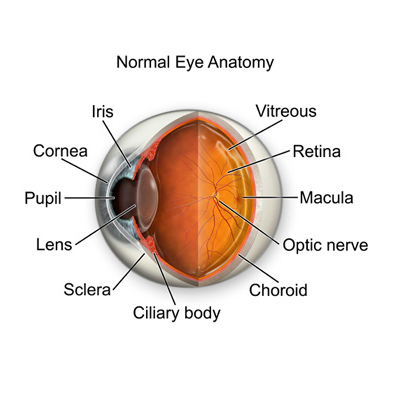
Eye Anatomy
| CORNEA: | Transparent front segment of the eye that covers iris, pupil, and anterior chamber, and provides most of an eye's optical power. |
| PUPIL: | Variable-sized, circular opening in center of iris; it appears as a black circle and it regulates the amount of light that enters the eye. |
| IRIS: | Pigmented tissue lying behind cornea that (1) gives color to the eye, and (2) controls amount of light entering the eye by varying size of black pupillary opening; separates the anterior chamber from the posterior chamber. |
| LENS: | Natural lens of eye; transparent intraocular tissue that helps bring rays of light to focus on the retina. |
| RETINA: | Part of the eye that converts images into electrical impulses sent along the optic nerve for transmission back to the brain. Consists ofmany named layers that include rods and cones. |
| MACULA: | Small, specialized central area of the retina responsible for acute central vision. |
| VITREOUS: | Transparent, colorless, gelatinous mass; fills rear two-thirds of the interior of the eyeball, between the lens and the retina. |
| OPTIC NERVE: | Largest sensory nerve of the eye; carries impulses for sight from retina to brain. |
| SCLERA: | The white of the eye; a protective fibrous outer layer covers all of the eyeball except for the part covered by the cornea. |
| CILIARY BODY: | A muscular ring under the surface of the eyeball; helps the eye focus by changing the len’s shape and also produces aqueous humor. |
| CHOROID: | The vascular layer between the sclera and the retina; the blood vessels in the choroid help provide oxygen and nutrients to the eye. |